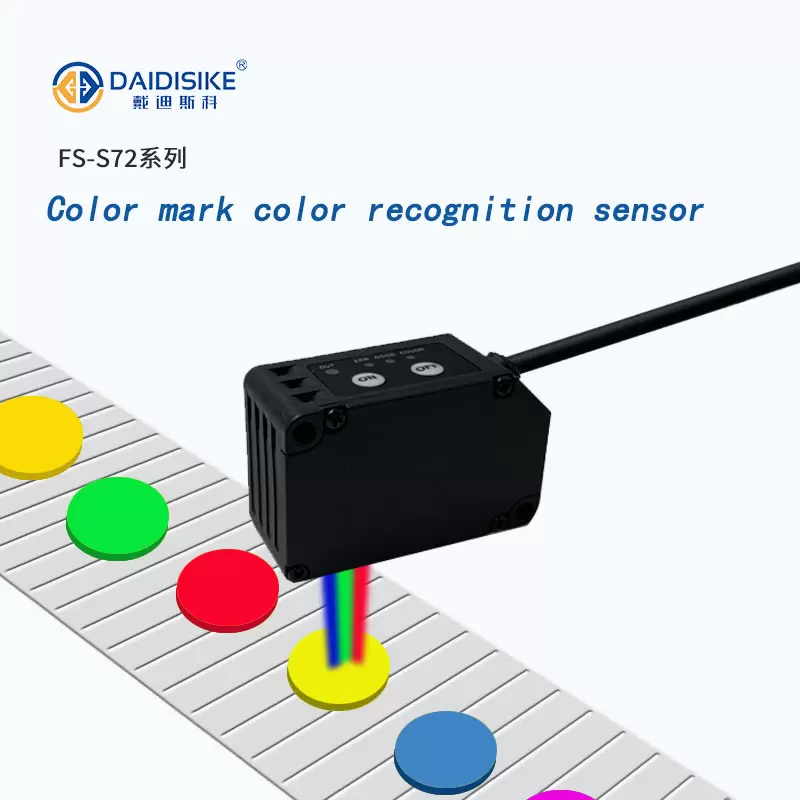
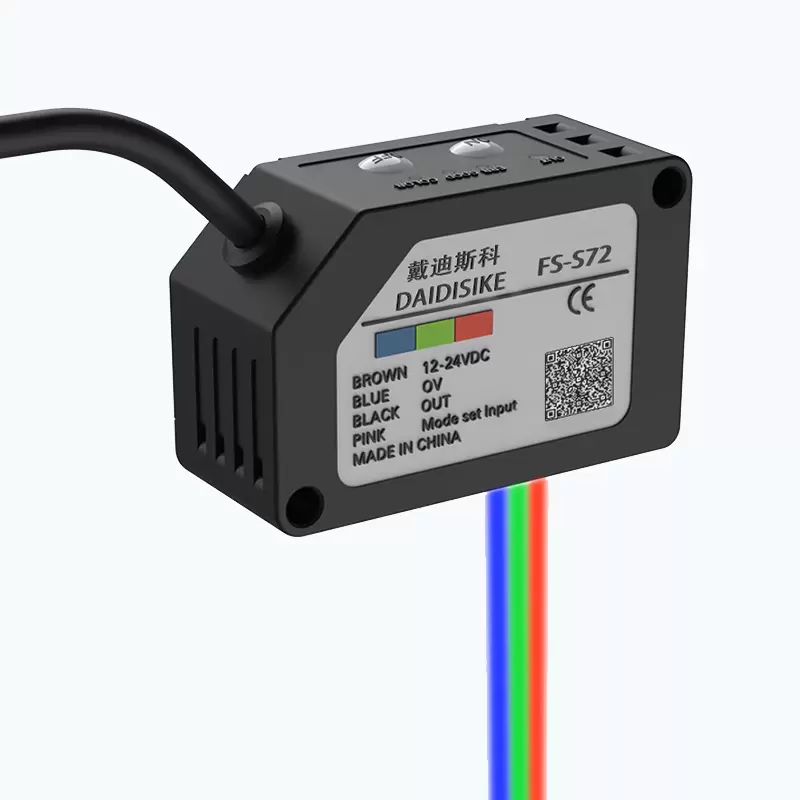
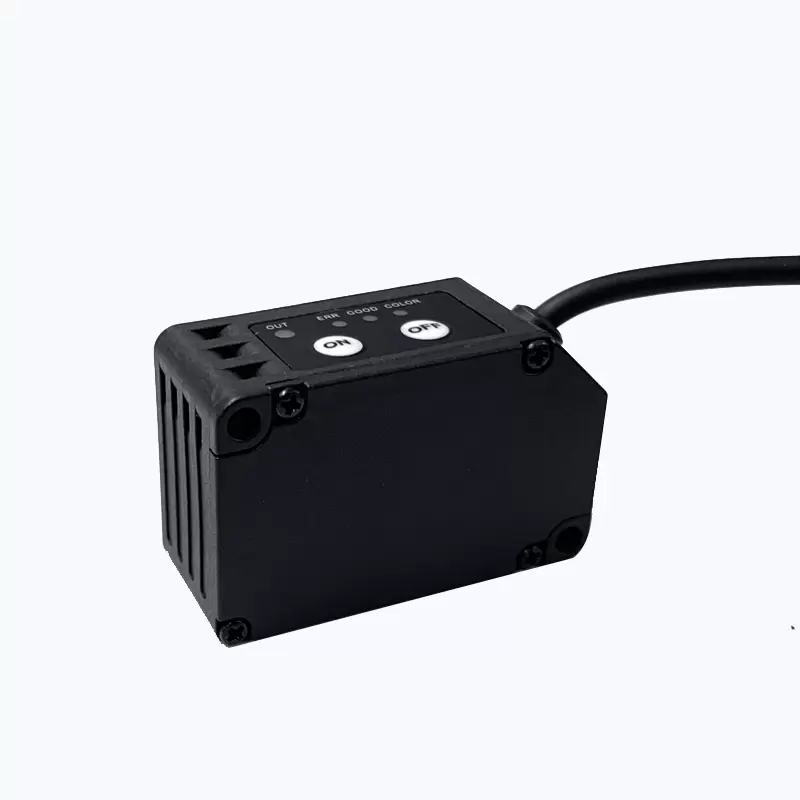
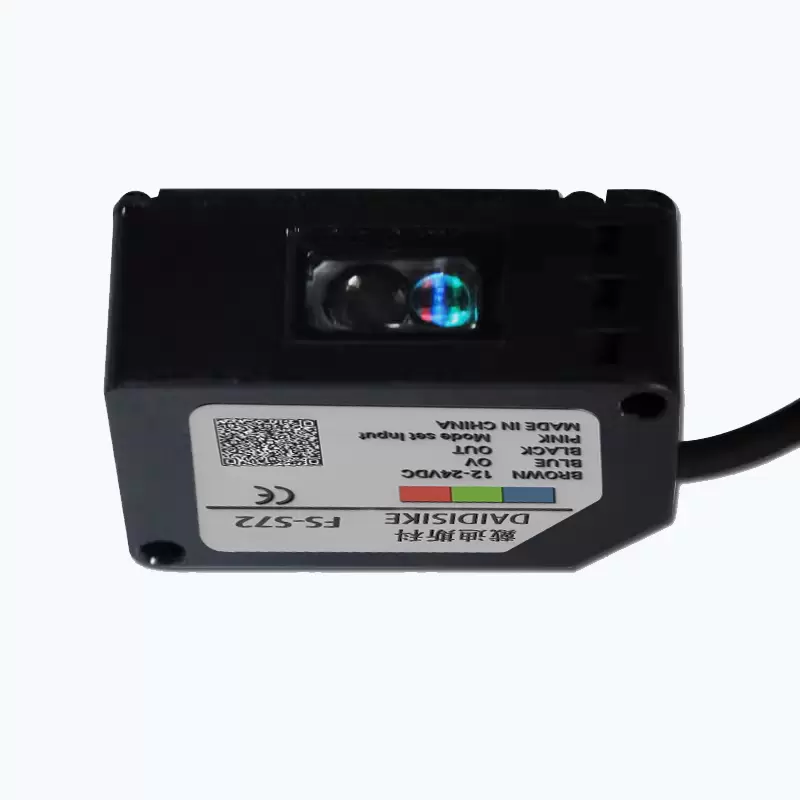
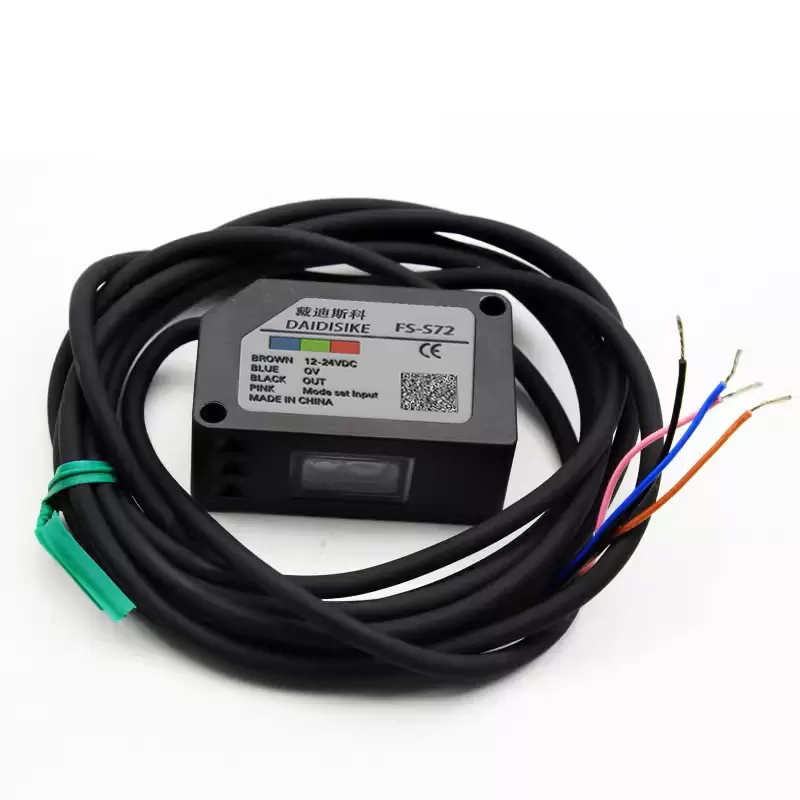
The FS-S72/FS-S72P color mark sensor is a compact color detection device specifically developed for high-speed packaging, printing, labeling, electronics, and other industries. Featuring a 1.5×7mm linear light spot design, it enables precise recognition of various color ribbons, trademarks, and positioning lines within a very small installation space. With a detection range of 18~28mm, it offers a 2~3 times improvement in effective distance compared to similar color mark sensors, making it easy to install in limited spaces such as knife shafts and pressure rollers, while still leaving sufficient mechanical safety clearance.
The sensor eliminates the impact of jitter on the measured object by adjusting detection accuracy, exhibiting strong adaptability to common jitter conditions such as high-speed conveyor lines, film rolls, and label tapes, and high anti-jitter performance. With the help of linear light spots, the FS-S72 series can achieve stable recognition at the edge of the measured object or at the critical position between two different colors. Whether it is a contrast between dark and light colors or the boundary between different color blocks, it can maintain clear switch points, with reliable and consistent detection results, making it very suitable for bag cutting, label cutting, register alignment, and web guiding control.
The product features both “color code mode” and “color mode” for detection:
* **Color code mode** is used to compare the color code with the background, achieving precise positioning of high-contrast markings;
* **Color mode** identifies the target color itself and can be used to detect specific color blocks, color printing patterns, etc.
By switching between two modes through external input signals, a single sensor can perform both positioning and color discrimination, offering significantly better performance than ordinary color-code detectors with a single function.
The setting method employs two-point teaching: align the color code to be measured and press the SET button, then align the background and press the SET button to complete the operation. The operation is very simple, and ordinary operators can learn it in a few seconds. The sensor is compact in size and features a side-outlet structure, allowing it to be flexibly installed in various narrow spaces and inside fixtures without affecting the original layout of the equipment.
In terms of electrical specifications, FS-S72 features NPN open collector output, while FS-S72P features PNP open collector output. Both have a maximum output current of 50mA, allowing direct drive of PLC inputs or relay coils. The external voltage should be below 30VDC (not exceeding the power supply voltage +V2), with a residual voltage not exceeding 1.5V, making it suitable for standard 24V industrial control systems. The power supply voltage is 24VDC±10%, with ripple P-P below 10%, and the maximum power consumption does not exceed 850mW (consuming approximately 35mA at 24V), ensuring energy efficiency for long-term operation. The output circuit is equipped with automatic short-circuit recovery protection, effectively preventing damage caused by miswiring or load short circuits.
The light source utilizes a composite LED, encompassing three wavelengths (approximately 640nm, 525nm, and 470nm) of red, green, and blue. It is compatible with various printing colors and materials, ensuring a good detection margin for targets with different reflective characteristics such as paper, plastic film, and metal foil. With a sensor response time of less than 200µs, it can easily meet the high-speed detection requirements of high-speed packaging machines, slitting machines, and labeling machines. In terms of environmental adaptability, it operates stably within a temperature range of -10 to +55℃ and a humidity range of 35 to 85%RH, without frosting or condensation, meeting the requirements of most conventional factory sites.
Overall, the FS-S72/FS-S72P color code sensor strikes a good balance between size, detection range, anti-jitter performance, and dual-mode detection function, making it highly suitable for automation equipment that requires stable color code identification, such as flexible packaging printing, label die-cutting, color box packaging, and lithium battery coating positioning. It provides users with a cost-effective color code detection solution.